
The Accelerationist Gamble
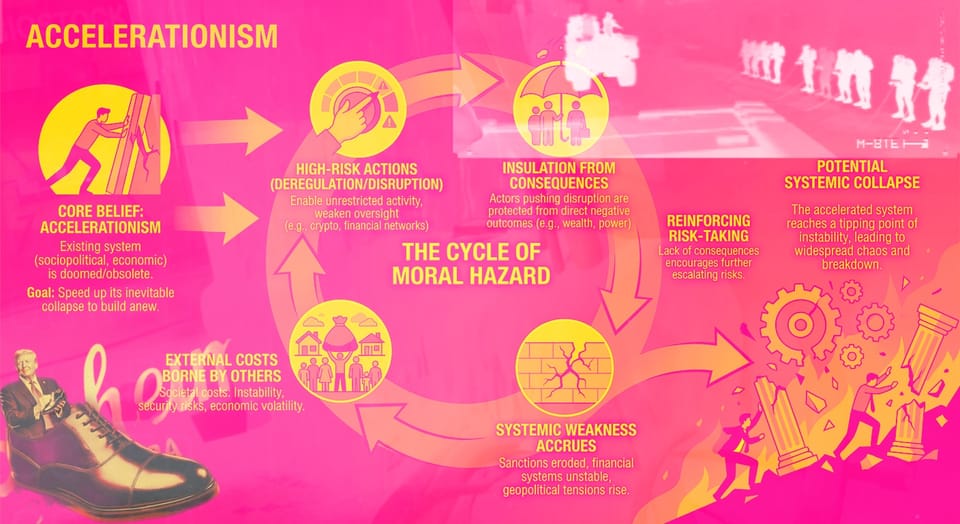
In the world of global finance and geopolitics, a dangerous new doctrine is taking root in Washington, D.C., one that prioritizes immediate, disruptive wins over long-term stability. While often dismissed as fringe ideology, accelerationism, the belief that the existing sociopolitical and economic system should be intentionally accelerated toward collapse to build something new, is increasingly defining the actions of the second Trump administration, particularly in its handling of cryptocurrency and national security.
This report untangles a complex web of presidential pardons, dropped federal lawsuits, and family business ventures that critics argue are not only eroding U.S. sanctions enforcement against adversaries like Iran but are also creating profound "moral hazards" that threaten to consume the very actors engineering them.
Part I: The Crypto Backdoor and the Iran Connection
To understand the stakes, one must look at Binance, the world’s largest cryptocurrency exchange. In late 2023, Binance pleaded guilty to massive violations of U.S. anti-money laundering and sanctions laws, agreeing to pay a historic $4.3 billion fine. Its founder, Changpeng Zhao (CZ), admitted to knowingly allowing sanctioned entities, including users from Iran, to trade on the platform, facilitating the movement of hundreds of millions of dollars outside the regulated banking system.
The rationale behind these enforcement actions was clear: preventing the financing of terrorism and state-sponsored aggression. However, since returning to office in 2025, President Trump has systematically dismantled the guardrails the previous administration spent years erecting around Binance.
The moves were swift and decisive:
1. The SEC Capitulation: In May 2025, the U.S. Securities and Exchange Commission (SEC), under new leadership appointed by Trump, voluntarily dropped its sweeping civil lawsuit against Binance "with prejudice," permanently ending allegations of market manipulation and investor deception.
2. The Presidential Pardon: In October 2025, Trump issued a full pardon to CZ, nullifying his criminal conviction. Trump framed the prosecution as a political "witch hunt," ignoring the detailed admissions of guilt regarding sanctions evasion.
The consequences of this deregulation were immediate and predictable. By early 2026, intelligence reports indicated that Binance had once again become the preferred financial conduit for Iranian proxy networks. Investigators are currently tracing over $1.7 billion that reportedly flowed through the exchange to fund militant groups in the Middle East.
Critics argue that by prioritizing deregulation and protecting crypto allies, the Trump administration is indirectly funding U.S. adversaries.
Part II: The Nexus of Public Policy and Private Profit
The administration's motivations become clearer when examining the Trump family's deepening personal stake in the crypto industry. Shortly before the deregulation of Binance, the Trump family launched World Liberty Financial, a decentralized finance (DeFi) venture.
This creates an unprecedented conflict of interest. Financial reports indicate that Binance reportedly provided crucial technological support for World Liberty Financial’s stablecoin, USD1. Furthermore, international investment funds have used USD1 to purchase significant stakes in Binance.
This intertwining of personal financial interests and public policy is a hallmark of the administration’s approach. By protecting Binance, the President is simultaneously protecting his family’s business partners and investments.
Part III: Understanding Accelerationism and "Moral Hazard"
To the casual observer, creating pathways for adversaries like Iran to evade sanctions seems irrational. However, within the "accelerationist" circles that influence the administration's policy, this disruption is viewed as a necessary tool.
Accelerationists operate on the belief that the current global financial order—dominated by the U.S. dollar and regulated Western banks—is inherently corrupt or obsolete. By actively weakening this system (e.g., by enabling alternative financial networks like Binance, even if used by adversaries), they hope to accelerate its collapse, paving the way for a decentralized, crypto-based economy they control.
This strategy relies on embracing extreme moral hazard. In economics, moral hazard occurs when one party takes risks because they believe they will not bear the full consequences of those risks. The Trump administration is taking massive geopolitical risks—weakening sanctions, enabling illicit finance—believing that they (and their allies) will benefit from the resulting chaos or economic shift, while the broader public bears the security costs.





Member discussion