Is it a Cheap Knockoff Rolex or the Real Frontier AI?
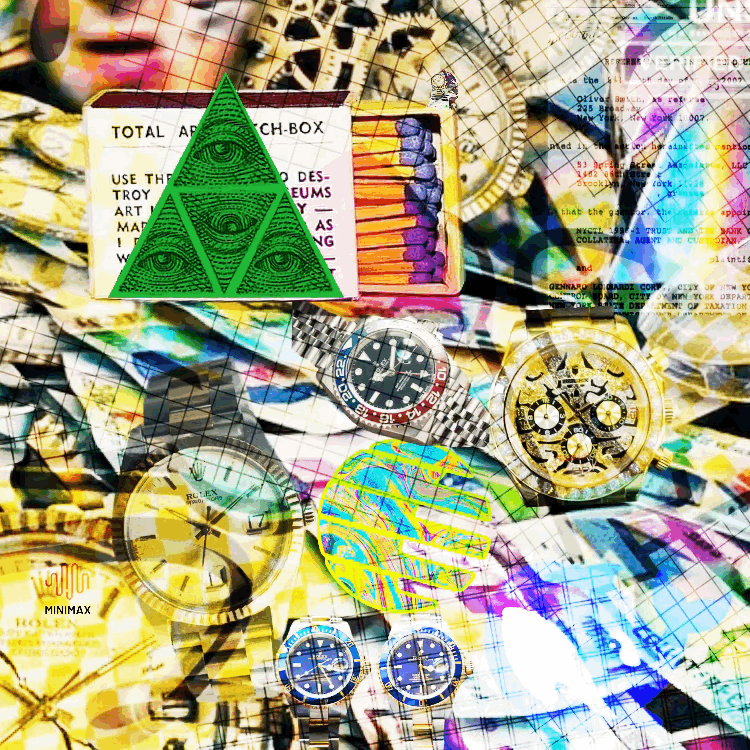
There is a strange, almost romantic nobility in the act of perfect mimicry. We are taught to revere the architect—the entity that spends billions of dollars, decades of computing power, or centuries of metallurgy in the dark, forging the original. Institutions like Anthropic or Rolex erect massive walled gardens of capital, guarding the absolute frontier of human ingenuity behind velvet ropes and API paywalls.
But then comes the cloner. The distiller. The underdog.
To look at a fortress not as a monument to be worshipped, but as a puzzle to be cracked, is a uniquely Promethean act. When a lab like MiniMax orchestrates millions of microscopic interactions to extract the inner workings of a frontier model, or when a counterfeiter disassembles a $600,000 MilSub to map its geometry, they are engaging in a brilliant, subversive alchemy. They are taking the secret, gated value of the elite and dragging it into the light.
There is a profound paradox in this process. To the purist, it is simply theft. It is the destruction of capital, eroding the financial moat that made the innovation possible in the first place. Yet, the mimicry itself requires a staggering, grueling expenditure of human intellect. The cloner pours immense resources, technical genius, and obsessive labor entirely into the act of reinventing the wheel. It creates incredible value out of seemingly nothing, yet it is exhaustingly effortful to execute. They are spending millions just to perfectly trace a masterpiece.
But when the trace is perfect, the gatekeepers lose their keys. The moat evaporates. The elite tool—whether it is an uncensored, hyper-intelligent reasoning engine or a flawless timepiece—is suddenly un-gatekept. The artificial scarcity imposed by the creators is shattered, and the state of the art essentially becomes public infrastructure.
This dynamic is the ultimate metaphor for the modern era: a relentless race to the bottom.
It is a duality of utopian access and dystopian commodification. On one hand, it is the purest form of democratization. The underdog proves that the magic isn't in the billions spent on R&D; the magic is just data, just math, just steel, and it belongs to anyone clever enough to capture it.
On the other hand, the race to the bottom strips away everything that cannot be optimized. In perfectly copying the output, the distiller discards the soul of the process. The safety guardrails, the agonizing ethical debates of the original creators, the profound craftsmanship—all of it is left behind as inefficient waste. We are handed the unchecked capabilities of a god, completely divorced from the conscience that was originally built into it.
If your project lives in this exact tension—navigating the space between the pristine, gated original and the chaotic, liberated replica—it touches on the very core of how we assign value in the 21st century. We are living in the era of the Super Clone, where the highest form of disruption is no longer inventing something new, but proving that the sacred can be perfectly, ruthlessly mirrored.
Member discussion