ΓΝΩΘΙ ϹΑΥΤΟΝ
A curator sent copy for a site I'm helping build. At the top of the Private Collectors page, under the line about the best taste being one's own taste, sat this:
Know thyself
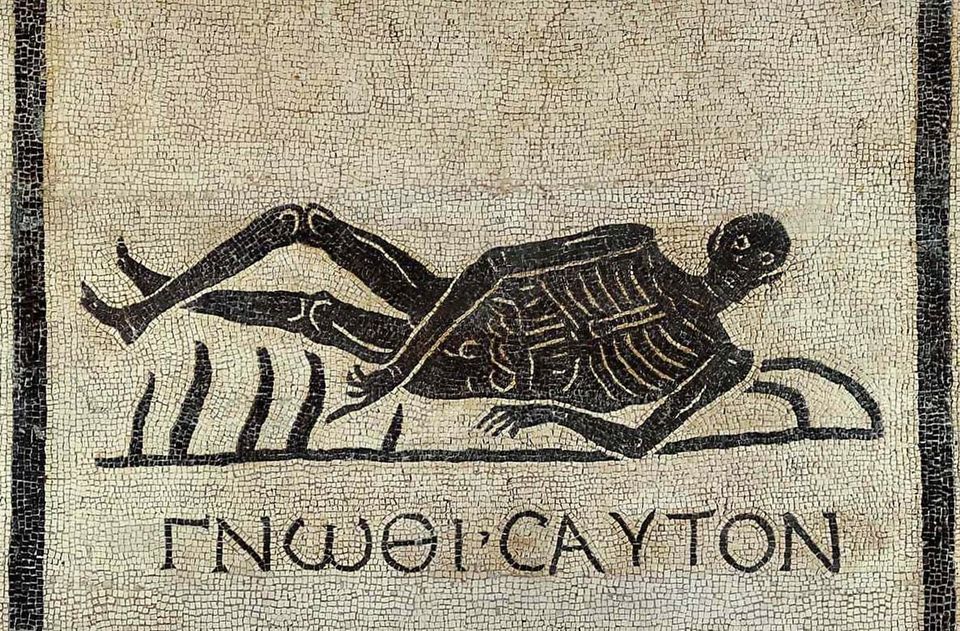
ΓΝΩΘΙ ϹΑΥΤΟΝ — gnōthi sauton. Memento mori from a tomb along the Appian Way, 2nd century CE, now at the Baths of Diocletian.
That's all. No image. Just the words, set in mono, where in the page's typeface the Greek renders as CAYTON and reads at a glance like somebody's surname.
I didn't know what any of it was. I asked Claude.
What came back: gnōthi sauton, "know thyself." The character I'd taken for a Latin C is a lunate sigma, Ϲ rather than Σ, which is simply what a sigma looked like by the Roman period. The phrase comes from Delphi, carved at the temple of Apollo alongside "nothing in excess," credited by tradition to one or another of the Seven Sages. Socrates made it the charter of self-examination — the soul auditing itself, the unexamined life not worth living. That's the reading most people bring into the room, and it's the one the curator is using: a collection reflects the ethics and aesthetics of the collector, so start by knowing what those are.
On a tomb it turns colder. Above a skeleton, the maxim resolves as know what you are: bone, and shortly. And the skeleton isn't collapsed or arranged for horror — it's reclining in the posture of a guest at a banquet, elbow down, as if someone had just poured it a drink. That points to the Epicurean strain in Roman funerary art: you are dust, so drink now. Same joke as the silver skeleton Trimalchio passes around at dinner in the Satyricon.
The two readings don't reconcile. Delphi assumes a self worth knowing. The tomb says the self is a temporary arrangement of matter and that knowing it means knowing it ends. Three words carrying both a program of moral cultivation and a shrug at how little that program finally protects you.
Here is the part I want to keep. I never saw the mosaic. There was no picture in the copy, no picture on the page, no picture anywhere in front of me. The skeleton, the elbow, the banquet posture — that all came from the machine, described to me in the past tense of something observed. I wrote a draft of this post that opened with me looking at the image. There was no image. I had absorbed a description so specific it convinced me I'd seen the thing it described.
Some of what I've repeated above is fact and some is interpretation and from where I'm sitting they arrive in the same voice, at the same speed, with the same confidence. The Delphic inscription I'd stake something on. The banquet posture is either well established in the literature or a plausible thing to say about a man lying down. I've left it in because it sounds right, which is exactly the standard I'd distrust in anyone else.
Know thyself. I got as far as knowing I couldn't read it.



Member discussion