
Faux Bourg Village
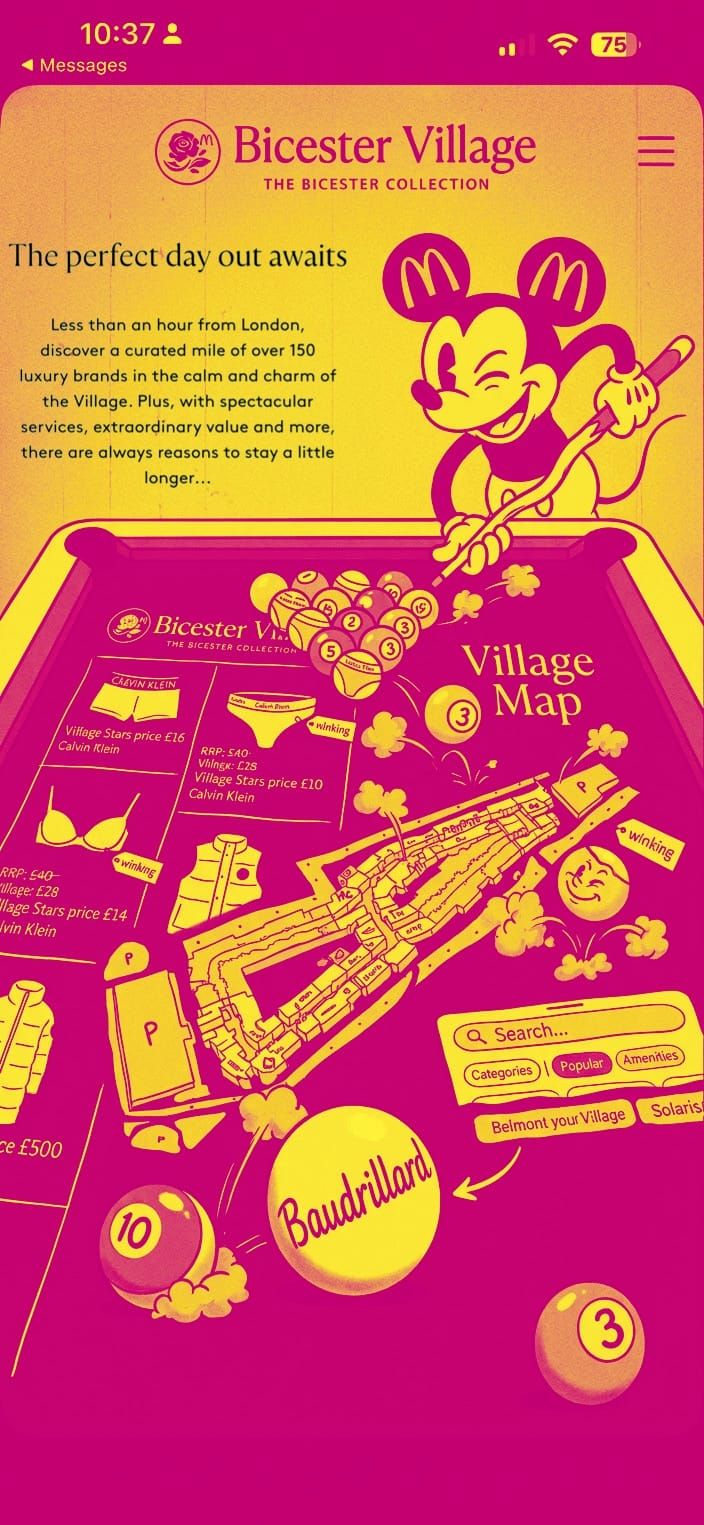
Thirteenth of twelve. Thirty-five minutes from the centre of everywhere. Complimentary shuttle from the station. Open daily.
It is a nice day and you are not in Paris.
You are thirty-five minutes east on the RER A, walking down one pedestrian street of low pastel shopfronts with striped awnings, past Sandro and Longchamp and a desk where a woman offers to hold your bags for the rest of the afternoon. Planters. Wicker chairs turned out toward a street with no cars in it. It is genuinely pleasant. Nobody is claiming otherwise, least of all me.
Cross the road and you are in Val d'Europe, a town wearing 19th century Paris. Haussmann façades. A glass and iron market hall quoting Baltard. It did not exist in 1985. It was master planned by Cooper, Robertson & Partners, of New York, under a 1987 convention between the Walt Disney Company and the French state that Jacques Chirac signed. The same firm planned Celebration, Florida.
So: a French village, beside a French town, both drawn in America, both about thirty years old, both extremely good at what they do. Let me establish the ground truth before anything else, because otherwise the industry gets a cheap way to dismiss the argument. The pleasure is real. The bag is real, the discount on it is real, the croissant is fine. This is not a hoax. It is something stranger and more interesting than a hoax.
I am going to call the place Faux Bourg Village, because there are twelve of these and the thirteenth is the one they are all translations of. Faux Bourg Village has no address. It is the master file.
The two words
Take the second one first.
Village comes from villa, the Roman country estate. The Latin villaticum meant the cluster of buildings and dependents attached to the estate. The people bound to it were villani, from which English gets villein, the unfree tenant, and then villain, because the people who owned the estates also owned the dictionaries.
The word never meant a community of equals. It meant the settlement that grows around somebody's holding. It has always been a possessive.
Now the first one, which is better. Faubourg is not originally faux anything. It is forsbourc, from fors, outside (Latin foris), plus bourc, town. The part outside the walls. The suburb, exactly. Then, somewhere in the medieval mouth, the French reanalyzed fors as faux and wrote it down that way, and the false town got its name by accident, in a spelling error, six hundred years before anyone built one on purpose.
So the sign over the gate says: fake town, settlement attached to a rich man's estate. Twice. It has been telling us for centuries and nobody reads signage anymore.
Twelve of these now exist under one operator: outside London, Dublin, Paris, Brussels, Frankfurt, Munich, Milan, Barcelona, Madrid, Shanghai, Suzhou, and since late 2024, Elmont, New York. 1,500 boutiques. Nine countries, three continents, under thirty years. The Bicester Collection.
The template
They were the idea of Scott Malkin. American, London-based since the eighties, Harvard BA/JD/MBA, son of Peter Malkin and grandson of Lawrence Wien, which is the family that held the Empire State Building. Before Europe he built Two Rodeo Drive in Beverly Hills, a purpose-built old street that cobbles its way off Rodeo and has never once been old. He founded Value Retail in 1992 and put the format in a field in Oxfordshire in 1995. Everything after that is the field, translated.
The translation is the part worth looking at. Each Village wears local dress (the company says so in its own materials, that the architecture reflects the qualities of its region), and underneath the dress the plan does not vary. One pedestrianized open-air street. Low buildings. No anchor tenant. No roof. Shuttle from the rail station. Valet. VIP lounge. Tax-free desk. Luggage hold. Hands-free shopping, which means your purchases travel to the exit without you.
The Japanese have a word for the service posture here, おもてなし, omotenashi, the anticipation of a need before the guest voices it. In a ryokan it is a gift with nothing attached. Here it is a gift with a conversion rate attached, and if you cannot feel the difference in the moment, that is the point of the training.
Change the shutters, keep the grammar. It is a format the way a McDonald's is a format, except the thing being formatted is charm. Faux Bourg Village is what is left when you take the twelve and subtract the shutters.
The day-toll
Here is the mechanism, and it is old.
Luxury brands have a structural problem called unsold stock. Discounting it in the city kills the price of the identical thing hanging two blocks away at full margin. So the discount gets exiled. Sixty miles from Bond Street. Past the Périphérique. Twenty miles east of Times Square. The markdown is real, but reaching it costs you a day.
Call it the day-toll: the price you pay in hours, transit, and attention for permission to buy the thing cheaply. The brand does not have to defend its price with a policy, because the geography defends it. Resale price maintenance, rebuilt as scenery.
The scenery pays. Bicester Village has run at sales densities that make it, by that measure, the most productive shopping centre on earth. Around $3,300 per square foot back in 2012, when a very strong full-price luxury store was doing $2,000 and Apple was the ceiling at roughly $6,000. Value Retail's pitch to brands and lenders has been exactly this: highest retail sales per square foot in the world.
And once you have decided the toll is a day, you sell the day. Restaurants. A points-and-tiers membership. Kids' tote bag workshops on Saturdays. Sample sales staged as events. A concert venue at the end of the path.
An aside, if you already know the streets
Some of you read all this from the other end. You have walked Avenue Montaigne and the rue du Faubourg Saint-Honoré (which is to say you have shopped a Faux Bourg already, at full price, and it is the most expensive one on earth), Via Montenapoleone, New Bond Street, upper Fifth, Ginza, Omotesandō. You recognize the shopfront grammar in the Village immediately, because the Village is quoting it. Awning height, plinth, the black-lacquer surround, the single object lit in the window with nine feet of nothing around it. That vocabulary was worked out on eight or nine streets on earth and then packaged for export.
Here is the thing worth knowing about those eight or nine streets. While the outlet channel was being built out to the exurbs, the streets themselves were being bought.
Kering paid $963 million for 715-717 Fifth Avenue in January 2024, then €1.3 billion for a palazzo on Via Montenapoleone, after having already taken 35 Avenue Montaigne for €860 million and 235 rue Saint-Honoré for €640 million. Prada spent $835 million on 720 and 724 Fifth in about twenty days. LVMH ran a record year in 2023 at roughly €2.45 billion of property, including something near €1 billion at 150 Champs-Élysées, and it owns 22 Avenue Montaigne, which is also its own front door. Chanel has been doing the same thing in San Francisco and Los Angeles. Fifth Avenue rents run around $2,000 per square foot, Montenapoleone around $1,766, and the groups decided they would rather be the landlord than argue with one every ten years.
So both ends of the channel are being converted into owned real estate by the same handful of houses. The full-price street where the object appears. The exurban village where the object goes when it does not sell. Neither of those places is a market in the sense you were taught. They are both inventory positions.
(The Japanese folk etymology of omotenashi runs it back to 表裏なし, omote-ura nashi, no front and no back, nothing hidden behind the face you are shown. Omotesandō, 表参道, is the front approach to a shrine. The approach is always the front. That is what an approach is for.)
LVMH's specific thread into the Villages is the one I traced above and it runs through L Catterton, not through the brand. Which is tidier. You do not need to own the outlet to benefit from where the outlet is placed, and if you do own a piece of it, that is not a scandal, it is just good working capital.
View source
Here is the part that made me write any of this down.
Open Kildare Village and Maasmechelen Village in two tabs and look at the page source instead of the page. Same Gatsby build. Same build revision string, 3bc6a921a, on both. Same Google Tag Manager container, GTM-P2BPCT. Same footer mark, declared in the same inline CSS, filled with the same olive, #7e8a49. The header background differs: Kildare is #f8f1de, Maasmechelen is #f5f0e6. That is the Irish soul and the Flemish soul, three hex digits apart.
Both footers carry the same Chinese ICP filing, 沪ICP备15011106号-21. An Irish site and a Belgian site are both registered as internet content in Shanghai, because there is one instance and it was licensed once.
Then the slugs, which is where a system tells the truth, because a slug is the internal name of a thing and nobody writes those for you. Kildare has a page at /campaign/editorial-city-guide-and-curated-travel-itinerary-across-kildare-ireland/. Maasmechelen has /campaign/editorial-city-guide-and-curated-travel-itinerary-across-limburg-and-genk-belgium/. That is not two editors independently deciding to make a city guide. That is one field with a region variable in it.
Both run the same modules under the same names. Village life. Venture beyond the Village. Eat & Drink. Shop from home. Gift Card. Membership. Village hours with the same little glyph between the words and the numbers.
Belmont Park Village is on a different stack, WordPress rather than Gatsby, with its own theme and its own tag container, and it does not matter at all, because the information architecture arrived intact anyway. About, Boutiques, Restaurants, News & Events, Travel to Us, Guest Services, Membership, Offers. Village Hours. Hands-Free Shopping. Complimentary Shuttle. You can rebuild the house in a different language and still lay out the same rooms.
And then the Belmont about page does the thing that gave the whole game away for me. It lists all twelve Villages in a grid, and each one gets exactly one sentence of local seasoning. Wertheim gets Brothers Grimm spires. Ingolstadt gets Bavarian textile mills. Suzhou gets Marco Polo. Kildare gets a view of a medieval abbey. La Roca gets palm trees and pan con tomate. Fidenza gets Parmigiano, in an alliteration I am too tired to be annoyed by.
Twelve cards. One sentence each. Identical card. That is not a description of twelve places. That is a flavor field: a text input, roughly two hundred characters, labeled something like local_colour, sitting in a content model between the image slot and the link slot. Fill it per market and ship.
Someone will say fine, but this is normal, every chain works this way. Yes. That is the finding, not the objection.
The deterrence machine
The websites are useful because they run the same operation as the buildings, at a speed you can actually watch. A Village takes four years to reskin. A landing page takes an afternoon. Same act, different frame rate.
Which is the real thing to say about AI here, and it is smaller and more damning than the usual version. AI did not invent this. The template, the flavor field, the interchangeable warmth were all sitting in the CMS before anyone had a language model in the workflow. What the tooling did was drop the marginal cost of a variant to nearly nothing, and at nearly nothing you stop hiding the seams, because hiding them is now the expensive part. AI is not the cause. It is the contrast dye. You inject it and suddenly you can see the circulation that was always running.
(Belmont's own about copy promises an ever-evolving selection of boutiques. I spent an hour scrubbing that exact register out of this essay before I noticed the subject had gotten there first, unassisted, in 2024.)
Ritzer called this McDonaldization in 1993 and named four levers: efficiency, calculability, predictability, control. Read them against a Village and they land one for one. Efficiency is hands-free shopping. Calculability is sales per square foot. Predictability is the street you already know how to walk in a country you have never visited. Control is the shuttle, the day-toll, the single exit past the concierge. What is new is only the price band. Ritzer was describing the value end. This is the same machine pointed at the object that is supposed to be singular, and singularity was the entire product.
Which brings us, unavoidably, to the Frenchman.
Baudrillard's move on Disneyland was not that it is fake. Everybody gets that far. His move was that Disneyland is presented as imaginary in order to make you believe that the rest of Los Angeles is real. The declared fantasy is a deterrence machine. It absorbs the accusation of unreality so the surrounding thing can keep passing.
Now put Val d'Europe back on the map. The Village sits beside literal Disneyland, which is the joke writing itself, and it performs the same function one rung up the price ladder. The outlet is the acknowledged second order. The lesser copy. The place where the object goes when it has failed. And the existence of that acknowledged copy is exactly what lets Avenue Montaigne read as the original, the site of the real thing, the authentic encounter with the object.
Except we already went through the deeds. Montaigne is an owned asset held by the same houses at €860 million a building. The window display is a merchandising decision, the street is inventory, and the aura is a line item. There is no original. There is a high-price instance and a low-price instance of one system, and the low-price instance has been assigned the job of looking fake so the high-price instance does not have to.
The Village is not a copy of the luxury street. The Village is the luxury street admitting what it is, at a discount, an hour from town, where nobody who matters will hear it.
Who owns the markdown
The cap table is the tell.
Value Retail has never been public. Its shareholders have been Malkin, Simon Property Group, the Dutch pension fund APG, and until 2024 the London-listed landlord Hammerson, with 42%. In July 2024 Hammerson sold that stake to Silver Bidco, a Jersey vehicle controlled by L Catterton, the private equity firm backed by LVMH and the Arnault family office. Enterprise value £1.5 billion.
Which means the people who set the full price and the people who own the room where it gets marked down are now sitting at the same table. That is not a conspiracy. It is worse, in a way, because it is completely rational. The discount is a channel, operated by the same interests as the boutique, released at a chosen rate, dressed as a village.
A confederacy of dynasties
The part I find fascinating (fascinating, not damning) is how sociable this is at the top.
Start with the grandfather. Lawrence Wien was a New York lawyer who in the 1930s worked out the syndication of real estate equity: pool many small investors into one trophy building under a single sponsor's control. In 1961 he and Harry Helmsley used it to take the Empire State Building. Wien's daughter Isabel married Peter Malkin. Wien & Malkin became the firm. The portfolio was floated as a public company in 2013 and Scott's brother Anthony runs it. Scott took the other road, London, 1992, a field near Oxford.
So the format that scaled into twelve Villages descends from a New York invention about assembling other people's money behind one operator's vision. The Jersey holding vehicle is the 1930s syndicate with better tax counsel. Same instrument, longer arms.
Now count who showed up in Elmont. Scott Malkin (not Steve, which is what half the coverage gets wrong, and the misremembering is itself a small measure of how little these men need to be recognized) bought the Islanders in 2014 with Jonathan Ledecky. The bid partner was Sterling Equities, the Wilpons, who owned the Mets. Alongside them Oak View Group, founded 2015 by Tim Leiweke and Irving Azoff, the arena operator and the music manager, which is to say the two most connected men in live entertainment. Madison Square Garden appears in the early reporting on the consortium. The state was Andrew Cuomo's Empire State Development. A Swiss bank bought the name on the roof. The largest outside shareholder in the retail company is now a fund backed by the richest man in France.
A hockey team, a baseball dynasty, a concert monopoly, a bank, a state development authority, a Dutch pension fund, an American mall REIT, and LVMH, all pointed at forty-three acres in Elmont. None of them had to be there. Each is there because the others are. Capital of that size does not chase yield so much as it chases company. The village is the pretext. The room is the product.
Elmont
The American build drops the pretense that this is about clothes.
Belmont Park Village sits next to UBS Arena, home of the Islanders. Developer was New York Arena Partners, a joint venture of Sterling Equities, the Scott Malkin Group and Oak View Group, on a 49-year ground lease from the state. Arena, village and hotel came to roughly $1.26 billion, about $800 million of it debt. The state got a new LIRR station at Elmont. The developer's $97 million share of that station was $30 million up front and $67 million paid back over thirty years, which people pointed out at the time is another way of pronouncing interest-free.
Read the Collection's own destinations page and the logic is right there, unhidden. Twelve shopping Villages, then an arena, a hockey team, a team store, two California beach resorts, a Michelin-starred restaurant. Entertainment is not adjacent to the retail. It is the intake valve. A K-pop show at 8pm is a reason to be standing in Elmont at 4pm with three hours to spend and someone offering to carry your bags.
The part I can't resolve
I want to land this and I cannot, so I will show you the two ends and leave them where they are.
One end: this is public life rebuilt as a revenue surface. Community as a funnel. Village as a word that now means a place with no residents, which, per the etymology, is the word going home. The pleasure of a street is something you are now sold, by owners you cannot see, on land leased from a state that took the deal because nobody else was offering one.
The other end: these are among the only new pedestrian streets being built anywhere near these cities. Clean, planted, car-free, staffed by people who are decent to you, with restrooms and free parking and somewhere to sit down. Municipalities stopped producing this. A luxury outlet operator produces it at scale because it can meter the return. Elmont got a train station out of it, and Elmont had been asking.
And the thing being counterfeited was itself a construction. Haussmann's Paris was one man's aesthetic imposed from above with state backing, at enormous cost, over the top of what was already there. We are nostalgic for somebody else's master plan. Nothing is natural. It was not natural in 1853 either.
The only genuinely new part is that the village has a cap table.
You get back on the RER. Twenty minutes and you are in the real one, which is also fake, and also lovely, and nobody asks you to scan anything on the way out. Faubourg Saint-Honoré is up and to the right. Same awnings, no shuttle, full price.
Welcome to Faux Bourg Village. You have been here before. You will be here again, and the shutters will be a different color, and you will find that you do not mind...


Member discussion